
14. Yalta
And more Latvians

For an Australian, used to miles of almost uninhabited, pristine beaches of white sand and surf, it is difficult to write about Yalta without seeming rude. The guide books extol the wonders of the beaches, the history, the dining, the art, and reading the brochure we wonder how we can possibly to see everything in the few days on our marschroute. But, after a few hours experiencing the reality of this holiday hell on earth we are attracted to the idea spending all our time inside the tent—and we would have, but for the fact that part of our movie is set in a holiday resort.
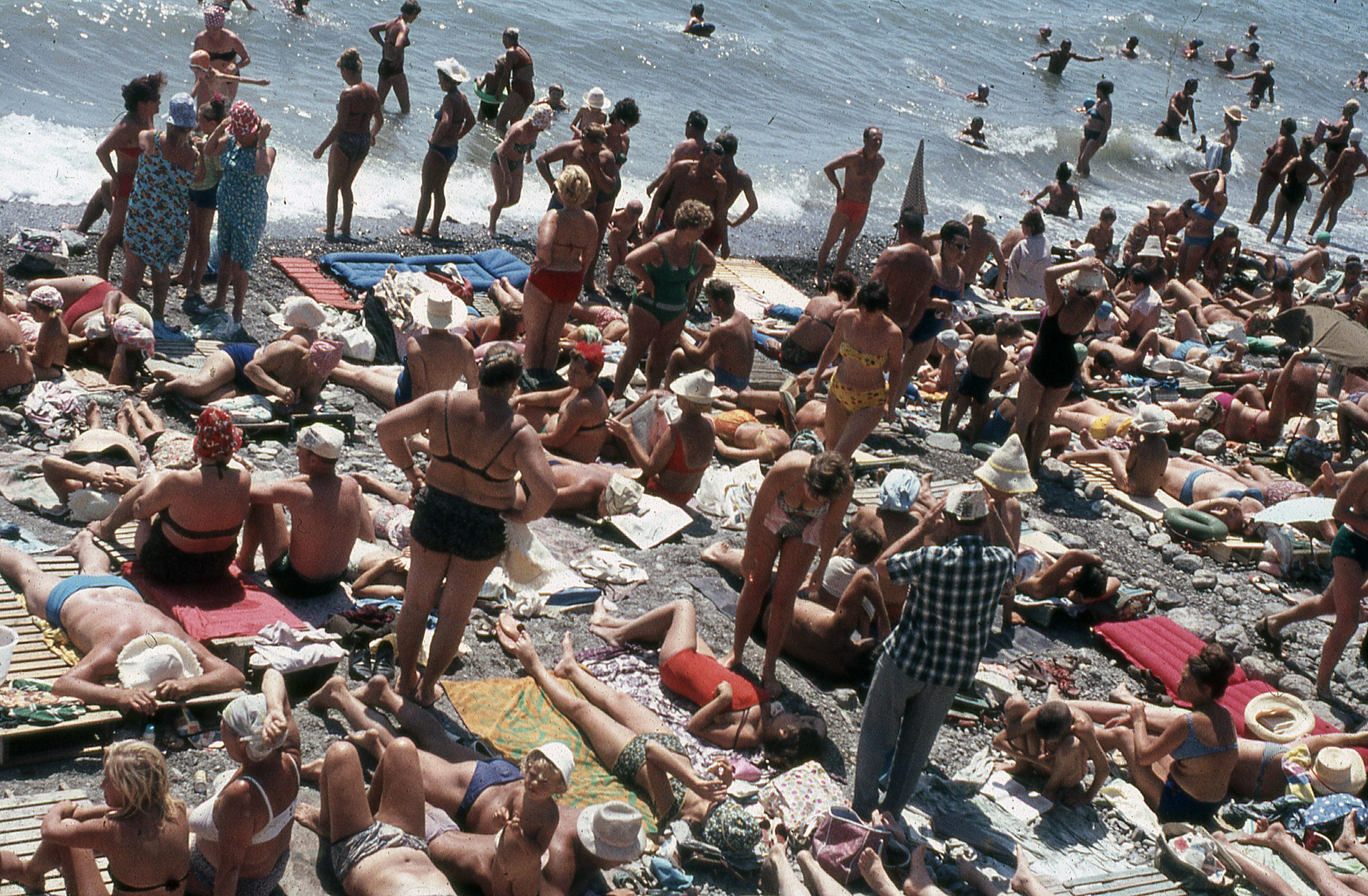
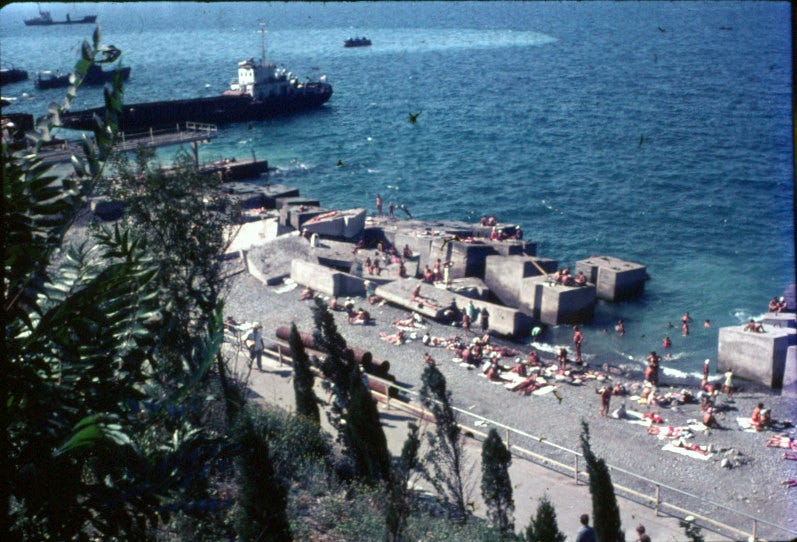
In some ways, Yalta is not so different from other holiday towns: bursting with with city folks on vacation; new Jerry-built apartments crowding out houses from Chekhov’s day that are now cramped into streets never designed for motor cars; cafes, souvenir shops, amusement arcades. But it differs from the Australian Gold Coast and the Costa del Sol in that the pervasive colours are grey and dun-coloured and the beaches are rock—not smooth round pebbles like the British beaches Australians mock, but hard, jagged sedimentary rock, seething with (as a disillusioned Swede described it) “tons of women” in skimpy bikinis, lounging on mattresses and wooden planks. The lukewarm sea laps in a half-hearted fashion on the shoreline and washes away the dirt. One of the most popular beaches in Yalta is a construction site, with huge cranes, lumps of concrete, wrecked oil tankers and piles of gravel. Needless to say, we did not join those brave enough to swim.
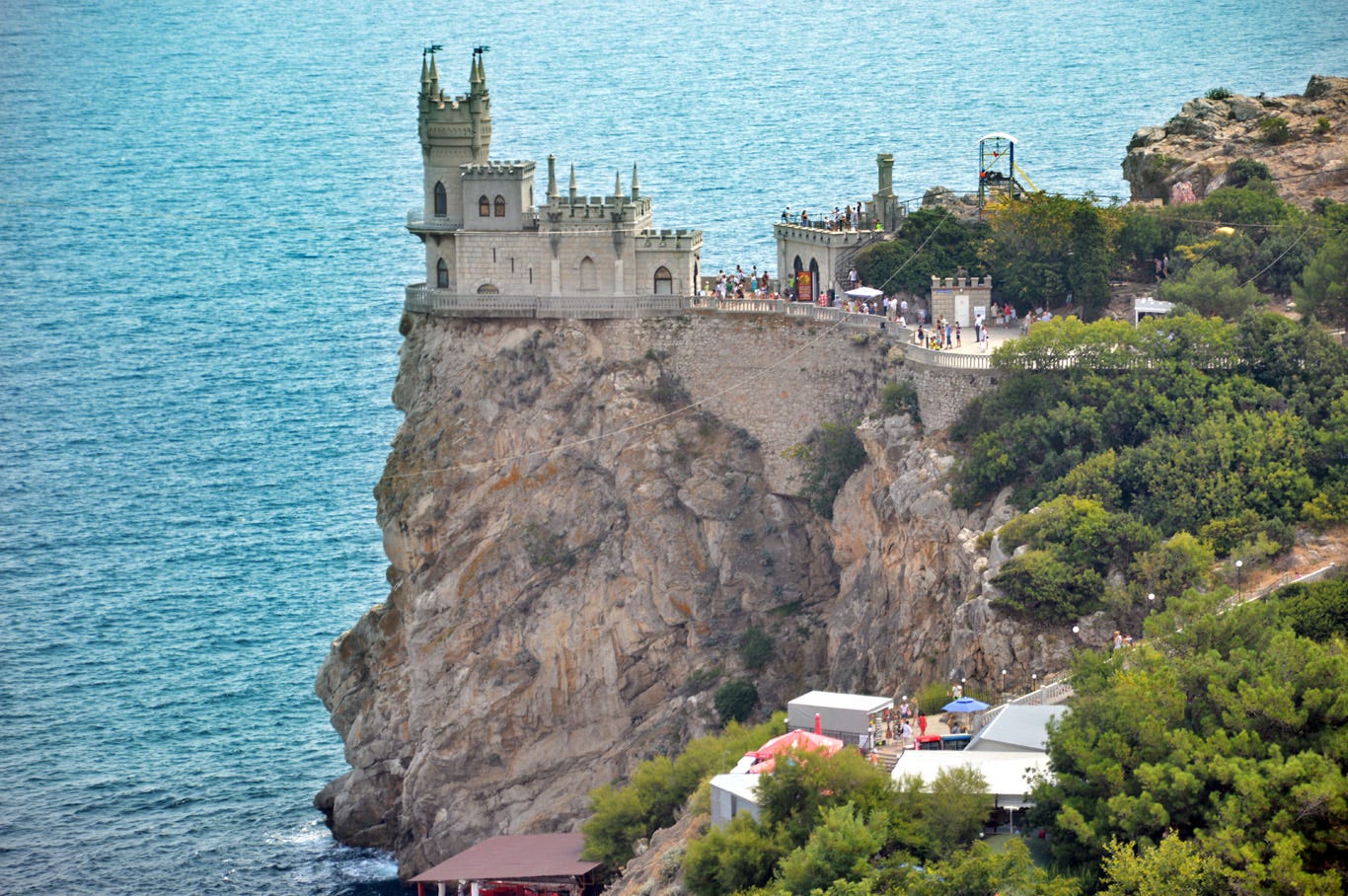
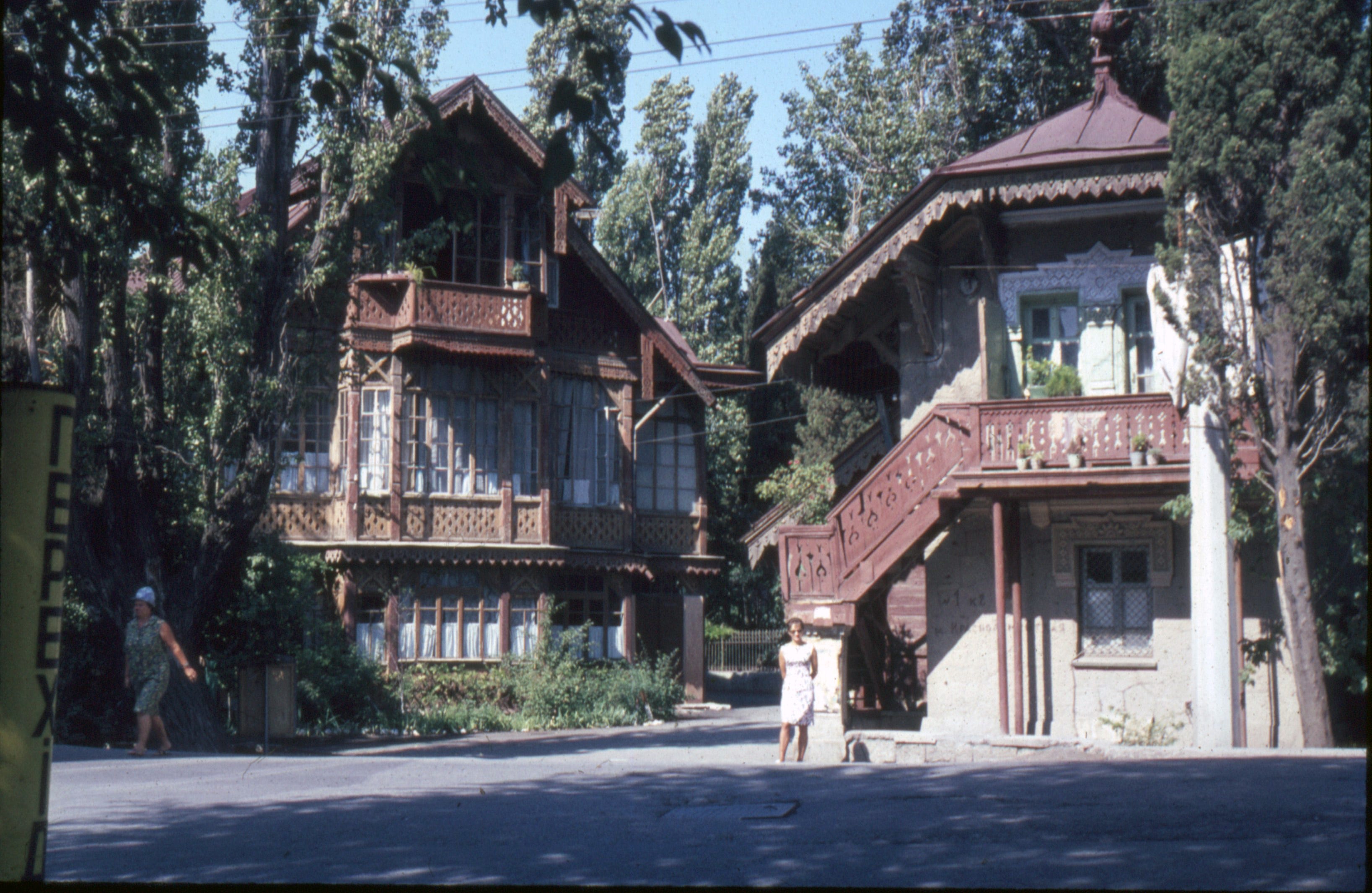
The only beautiful buildings are from the Czarist period and they are crumbling from lack of maintenance (though no faster than buildings constructed in the last decade). The famous “Swallow’s Nest” nearly collapsed into the sea and is being held up with wooden props (Note: it was restored in 2011) . The palace used for the 1945 Yalta Conference (Stalin, Churchill, Roosevelt), which sealed the fate of the Baltic countries and part of Romania, is now a grimy health resort.
We chat with two young fellows on the beach who are trying their hardest to get into the film. “How do we like Yalta?” they ask. “Very lovely,” we agree. “There are 10 million people in the Crimea at the moment,” they assure us, “and 120,000 in Yalta” We tell them that Australia has more beautiful beaches but they aren’t as crowded as this.
“There are no people on your beaches,” they explain, “because in Australia, workers don’t get any holidays” We offer a counter-argument to this all-too-common soviet slogan. “Very well, then,” he admits, “but even if they do get holidays they can’t afford to go anywhere. Everything is too expensive for the worker in the West.”
We have grown sick of this propaganda shoved down the throats of schoolchildren and believed by most. We point out that we are on holidays, our parents are workers (indeed refugees from Latvia), we bought our second-hand Kombi bus for 400 roubles in Germany and it runs better than your new 4,000 rouble Moskvich car. We leave them shell-shocked and maybe even wondering whether everything the learned at school is real.
We are tired after all this driving, in a bad temper and no longer willing to be polite when faced with these glib “facts” about the West. Austra’s Russian is improving and she gains the confidence to argue back: cornering ladies in the kitchen who dismiss us as rich capitalists; informing them about the British National Health system (they cannot believe that medicine is free anywhere in the world), and the medical insurance schemes in Australia and other decadent western countries. We find the killer argument is the example of our bright red German Kombi bus—a source of fascination in the camping areas. One night we overhear a woman telling her friends “You know their red bus—like our Riga Raf? They bought it for 400 roubles and will sell it for 300 roubles when they go home, so their holiday will only cost them 100 roubles!”
KOMBI THE ICE-BREAKER
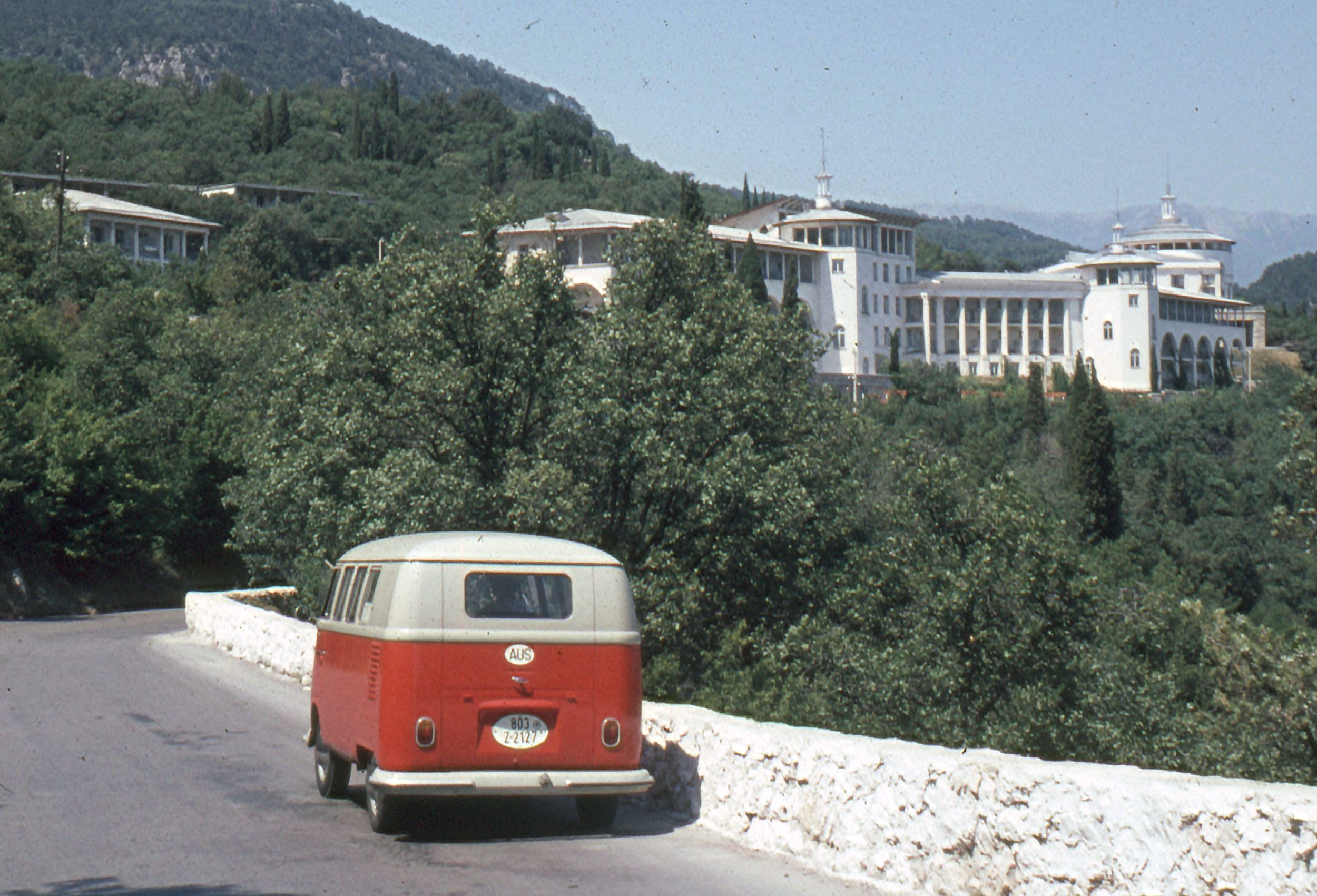
We meet another group of Latvians in the camp: two families who had travelled down by car for their vacation. One of the women is very voluble and parrots the Party line. When we argue that the cost of living is expensive in the USSR—pointing out that petrol is the same price as in the West—she waves a finger at us. “But our cars work on the cheapest petrol (66 octane) so they are much more economical with much better engines.”
The three men with her finally show some rebellion and ask Laimons to show them the wondrous Kombi and its legendary Volkswagen engine. One of them tells us he bought his Moscvich car in 1958 for 1,500 (new) roubles, before the price went up. As they have had it now for the required time, they could resell it for 1,000 roubles.
WAGES
The conversation inevitably turns from cars to income. An average wage in Latvia, they tell us, is 70-100 roubles per month. One of them, a first-class chauffeur, earns 130 roubles; another (an engineer) and his wife (schoolteacher) earn less than 300 roubles between them. An engineer on the shop floor has a top salary of 150 roubles per month. Tax averages about 6% and there are other “non-compulsory deductions” (their quotation marks): union fees, and various donations for funds and monuments. There are deductions for medical insurance, though we were never certain of the exact system. Free medicine is more of an ideal than a reality. All medicines are very expensive and in short supply.
HOLDAYS
The Party line woman was not to be dissuaded: “Oh, we can travel abroad with no problem at all! Money is the only objection, because travel in the West is so expensive! To go to Japan it would cost 8,000 roubles, though we could save it in two years... “
After we point out the fundamental weakness in her argument, she adds some more detail. When they go on organised tours to foreign countries like Czechoslovakia and Sweden, food and lodging are paid for in advance and each person can bring a maximum of 100 roubles spending money. They must stay together all the time and obey the guide. If the trip is to a non-Communist country only the husband or the wife can go—never both. Permission to travel abroad, if it is not an organised excursion, is difficult to obtain. One good reason, surprisingly, is to visit relatives, “Though it is not always granted,” she admits.
“But we are not badly off,” she maintains. “We can afford clothes, though we have to go without a few things to buy something nice. And of course we can’t afford 30 pairs of shoes a month like Mrs Nixon, so we can wear something different every day, but we can afford one pair for work and another for going out.”
“Latvia is industrial now!” she announces proudly. “It produces railway carriages, radios and electronic equipment, silk weaving and the Riga Raf—a vehicle the equal of your German Kombi.”
AGRICULTURE & THE PARTY LINE
She dismisses agriculture and fishing as unimportant bourgeois activities, although the standards have not gone down by any means. “There is a model collective farm in Lacplesis, which all tourists are taken to. It can lay a table equal to anything they had in the old days.”
She admits there are some collectives that are rather run down. “It depends on the director.” But state farms have picked up over the last few years, since they were reorganised. Under the old system the farm rented the land and hired the equipment from the state and paid it back in produce. In bad years when the farm fell into debt, the workers were paid nothing. Even in good years they had hardly enough to live on. This discouraged the agricultural labourers from working their hardest and encouraged them to spend their time on their own little plots of land. Under the reorganised system, the state owns the land and pays the workers a wage for piece work, to give incentives to work harder.
We tell her that everywhere in the Ukraine we see old ladies looking after a cow with as much care as a child. “Who owns the cow?” we ask. She explains that if they have a good work record, agricultural workers are allowed to own some land or a cow—a good cow can bring in 100 roubles per month. This is usually the way old people earn some extra money. Young people prefer to work harder for bonuses and ensuring their pension.
“In Latvia,” she says proudly, “there is a flourishing ‘private market’ where the old people bring their produce in for sale.” There is no price control and with competition, prices are much lower than in the shops for better quality, fresher fruit and vegetables. She is very proud of this example of soviet capitalism: “Russians are amazed to see the variety of produce available!” she tells us.
Later in our conversation, when she begins to depart from the straight “Party line”, she tells us she is a schoolteacher, and one of her duties is to visit the homes of truants. She constantly witnesses the drunkenness and the broken homes these children come from (as Alex constantly witnessed in #10 Two Teachers). An even worse influence, she tells us, is the port of Riga, where the children hang out on their “days off from school” and ape the foreign sailors. The less academic children, she says, have taken to dressing in dirty clothes and growing their hair long because official channels tell them that this is what Western youth like to do. “They think that to be dirty is to be Western!” she sighs.
She has personal knowledge of the deportations to Siberia, but clings to the Party line. Her mother and brother were deported in 1941, because her mother was “a bourgeois”, she says grimly. She owned a farm. Her brother died in Siberia, but “he would have been pardoned in 1956 had he lived”.
One of the men had been sent to Siberia in the second round of deportations in 1949. When the government had difficulty organising the countryside into collective farms, they solved the problem by deporting everyone who owned any land at all. According to our Party woman, it was not as harsh as 1941 (#11. The aunt’s story). This time, families were not separated and they stayed together in Siberia. They were told that they would never return, so many made their homes there and far fewer died.
I love these thank you. I wish I had enough knowledge to write a novel based on these times, it would be such an atmospheric story.